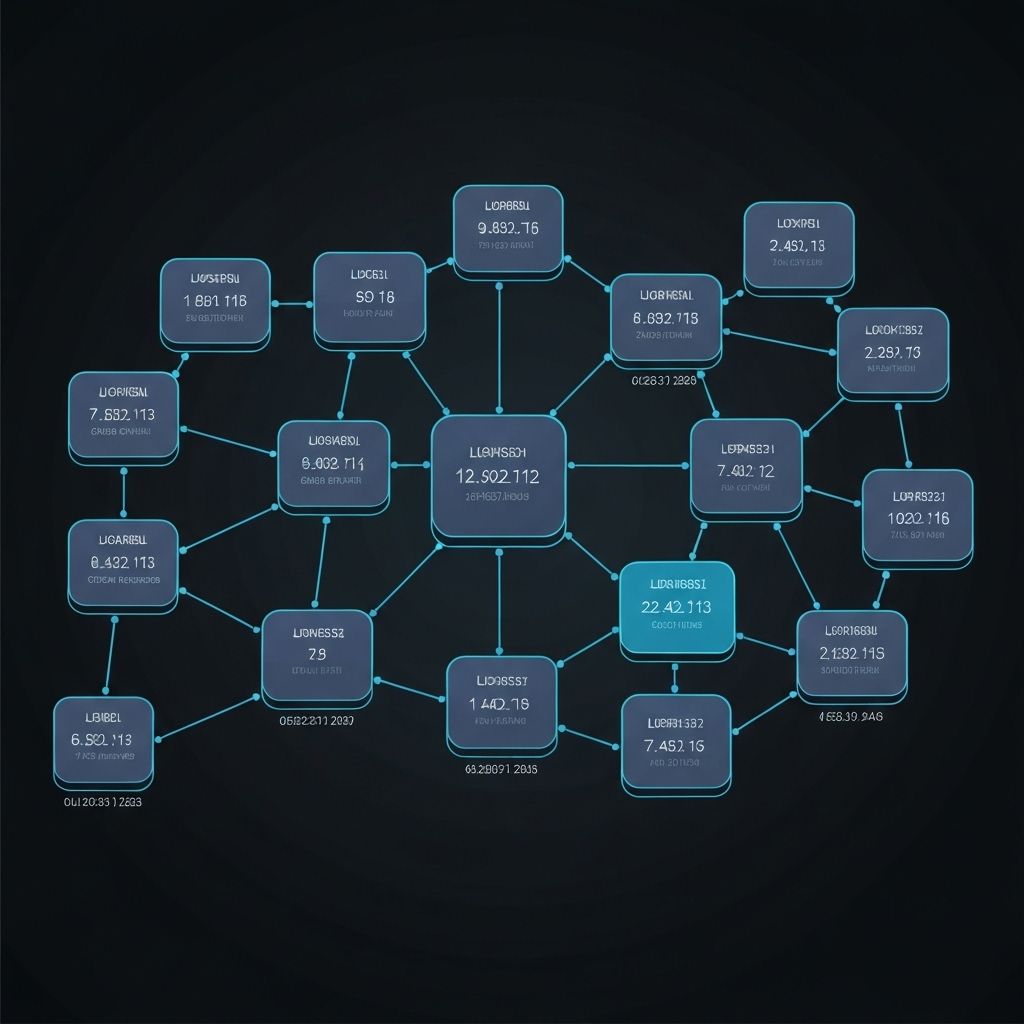
Blockchain Beyond Cryptocurrency: Real-World Enterprise Applications
Architectural Comparison: Public Ledgers vs. Permissioned Enterprise Ledgers
Enterprise systems require strict data confidentiality, high transaction throughput, and deterministic finality. While public blockchain architectures (such as Bitcoin or Ethereum) prioritize open participation and censorship resistance, permissioned enterprise ledgers (such as Hyperledger Fabric, Enterprise Ethereum, and Corda) focus on controlled membership, private channels, and custom consensus rules.
In a permissioned environment, network participants are vetted and authenticated via a Membership Service Provider (MSP) using Public Key Infrastructure (PKI). Unlike public nodes, which execute and validate all transactions globally, permissioned nodes are assigned specialized roles:
- Endorsing Peers: Receive transaction proposals, execute smart contracts (chaincode) in isolated runtimes (such as Docker containers), and sign the result.
- Orderer Nodes: Collect endorsed transactions, sort them into structured blocks, and distribute blocks to validating peers. They do not execute smart contracts themselves, which helps maintain high throughput.
- Committing Peers: Verify endorsements, validate block integrity, and commit transaction results to local state databases (such as CouchDB).
This division of labor enables parallel execution, sub-second latency, and horizontal scalability.
Consensus Protocols at Enterprise Scale
Enterprise blockchains replace energy-intensive proof-of-work consensus with crash fault-tol\x65rant (CFT) or Byzantine fault-tol\x65rant (BFT) algorithms.
Istanbul Byzantine Fault Tol\x65rance (IBFT) 2.0 is a common BFT algorithm used in enterprise networks. It divides time into consensus "rounds," with a designated proposer node initiating each round:
\x60\x60\x60 [Propose Round] -> [Pre-Prepare State] -> [Prepare State] -> [Commit State] -> [Write Block] \x60\x60\x60
- Pre-Prepare: The proposer broadcasts a block proposal to all validator nodes.
- Prepare: Validators validate the block proposal. If valid, they broadcast a "Prepare" message to all other validator nodes.
- Commit: Once a validator collects at least \x242f + 1\x24 matching Prepare messages (where \x24f\x24 is the number of tol\x65rated faulty nodes), it transitions to the Commit state and broadcasts a "Commit" message.
- Finalization: When a node collects \x242f + 1\x24 Commit messages, it writes the block to the ledger. This process guarantees instant finality: once a block is written, it cannot be reorganized or orphaned, avoiding the probabilistic settlement common in public chains.
Consensus Mechanics and State Machine Transitions in IBFT 2.0
Let us formulate the Byzantine safety requirements. A system with \x24N\x24 validator nodes can tol\x65rate at most \x24f\x24 faulty or malicious nodes, where:
\x24\x24\x24N \geq 3f + 1\x24\x24\x24
This ratio is necessary because a proposer might be Byzantine, sending different block proposals to different validators. The state machine enforces three confirmation stages:
- Stage 1 (Pre-Prepare): Proposer signs and broadcasts \x24Block_Proposal\x24.
- Stage 2 (Prepare): Validators sign and broadcast \x24Prepare_Message\x24. A node cannot transition to the commit phase unless it holds a supermajority of \x242f + 1\x24 Prepare certificates. This proves that no other conflicting block proposal can acquire a prepare supermajority within the same round.
- Stage 3 (Commit): Validators sign and broadcast \x24Commit_Message\x24. Upon receipt of \x242f + 1\x24 commit signatures, the state changes are written locally. The instant finality property ensures the transaction database behaves deterministically under network partitions.
Cryptographic Privacy via Zero-Knowledge Proofs
A major barrier to enterprise blockchain adoption is the visibility of ledger data. Competitors sharing a supply chain network need to verify transactions without exposing sensitive details like pricing, transaction volumes, or supplier identities. Zero-knowledge proofs (ZKPs) solve this by allowing a party to cryptographically prove that a statement is true without revealing any underlying data.
Let us evaluate the structure of a ZK verification system for supply-chain custody:
A smart contract verifies that a transfer of ownership conforms to environmental rules without disclosing the supplier's identity. The prover gen\x65rates a cryptographic proof \x24\pi\x24 demonstrating they possess a valid signature from an approved certifier:
\x24\x24\x24\text{Verify}(\text{vk}, \text{public_inputs}, \pi) \rightarrow \text{true/false}\x24\x24\x24
Where \x24\text{vk}\x24 is the public verification key, \x24\text{public_inputs}\x24 contains the hashed transaction output, and \x24\pi\x24 is the zk-SNARK proof. If the verification equation holds, the transaction is committed to the ledger, proving compliance without revealing raw business data.
Code Implementation: Solidity Enterprise Asset State Machine
Below is a production-grade Solidity smart contract representing an enterprise asset tracking system with built-in role control, state transitions, and private signature validation.
\x60\x60\x60solidity // SPDX-License-Identifier: MIT pragma solidity 0.8.20;
contract EnterpriseAssetTracker { enum AssetState { Created, InTransit, Inspected, CustodyTransferred, Retired }
struct Asset {
    bytes32 assetId;
    AssetState state;
    address currentHolder;
    address authorizedCarrier;
    uint256 lastUpdatedTimestamp;
}

mapping(bytes32 => Asset) private assets;
mapping(address => bool) private authorizedOrgs;
address public contractOwner;

event AssetRegistered(bytes32 indexed assetId, address indexed creator);
event TransitInitiated(bytes32 indexed assetId, address indexed carrier);
event CustodyUpdated(bytes32 indexed assetId, address indexed newHolder);

modifier onlyAuthorized() {
    require(authorizedOrgs[msg.sender], "Caller is not an authorized organization");
    _;
}

modifier onlyOwner() {
    require(msg.sender == contractOwner, "Caller is not the owner");
    _;
}

constructor() {
    contractOwner = msg.sender;
    authorizedOrgs[msg.sender] = true;
}

function authorizeOrg(address org) external onlyOwner {
    authorizedOrgs[org] = true;
}

function regist\x65rAsset(bytes32 assetId) external onlyAuthorized {
    require(assets[assetId].lastUpdatedTimestamp == 0, "Asset already exists");

    assets[assetId] = Asset({
        assetId: assetId,
        state: AssetState.Created,
        currentHolder: msg.sender,
        authorizedCarrier: address(0),
        lastUpdatedTimestamp: block.timestamp
    });

    emit AssetRegistered(assetId, msg.sender);
}

function delegateCarrier(bytes32 assetId, address carrier) external onlyAuthorized {
    Asset storage asset = assets[assetId];
    require(asset.currentHolder == msg.sender, "Caller is not the current asset holder");
    require(asset.state == AssetState.Created, "Invalid asset state");

    asset.authorizedCarrier = carrier;
    asset.state = AssetState.InTransit;
    asset.lastUpdatedTimestamp = block.timestamp;

    emit TransitInitiated(assetId, carrier);
}

function transferCustody(bytes32 assetId, address recipient) external onlyAuthorized {
    Asset storage asset = assets[assetId];
    require(asset.state == AssetState.InTransit, "Asset is not in transit");
    require(msg.sender == asset.authorizedCarrier || msg.sender == asset.currentHolder, "Not authorized to transfer");

    asset.currentHolder = recipient;
    asset.authorizedCarrier = address(0);
    asset.state = AssetState.CustodyTransferred;
    asset.lastUpdatedTimestamp = block.timestamp;

    emit CustodyUpdated(assetId, recipient);
}

function getAsset(bytes32 assetId) external view returns (Asset memory) {
    require(assets[assetId].lastUpdatedTimestamp > 0, "Asset does not exist");
    return assets[assetId];
}
} \x60\x60\x60
Line-by-Line Smart Contract Walkthrough
This Solidity contract enforces state validation patterns inside the Ethereum Virtual Machine (EVM):
- Enum Definition: \x60AssetState\x60 restricts valid physical custody phases. This is cheaper than string tracking, optimizing contract storage allocation.
- Access Control Modifiers: The \x60onlyAuthorized\x60 modifier interrogates the \x60authorizedOrgs\x60 state mapping. It throws a transaction revert if the sender address is unrecognized.
- Asset Registration: \x60regist\x65rAsset\x60 checks for duplicate keys by assessing the \x60lastUpdatedTimestamp\x60. If the record is empty (0), it creates a new storage struct.
- State Transit transition: \x60delegateCarrier\x60 updates the state variable to \x60InTransit\x60. This write execution gen\x65rates a \x60TransitInitiated\x60 log event, which indexers (like The Graph) listen for to update client dashboards.
Connection Profile Configuration for Peer Coordination
In Hyperledger Fabric, client applications int\x65ract with network nodes using a Connection Profile. This profile defines the TLS certificates, target URLs, and Membership Service Provider (MSP) boundaries of the validating and ordering services:
\x60\x60\x60yaml name: "raxcore-supply-chain-network" version: "1.0.0" client: organization: "RaxCoreLogistics" connection: timeout: peer: endorser: '300' organizations: RaxCoreLogistics: mspid: "RaxCoreLogisticsMSP" peers: - peer0.raxcore.logistics.com certificateAuthorities: - ca.raxcore.logistics.com peers: peer0.raxcore.logistics.com: url: "grpcs://peer0.raxcore.logistics.com:7051" tlsCACerts: path: "/var/hyperledger/configs/crypto-config/peerOrganizations/raxcore.logistics.com/tlsca/tlsca.raxcore.logistics.com-cert.pem" grpcOptions: ssl-target-name-override: "peer0.raxcore.logistics.com" hostnameOverride: "peer0.raxcore.logistics.com" \x60\x60\x60
Domain-Specific Challenges in Enterprise Ledger Systems
The State Database Sync Bottleneck
When a permissioned peer validates and commits blocks, it updates a state database (typically CouchDB or LevelDB) representing the world state. CouchDB allows rich JSON queries but exhibits high write latency. When processing high-frequency transactions, the state database can become a bottleneck due to lock contention on the ledger database files.
Engineers mitigate this by designing the world state keys to avoid high-concurrency access patterns (such as a single balance tracker) and instead utilizing append-only ledger entries combined with batch-update processors.
Key Lifecycle Management and HSM Integration
Unlike public chains where users manage their private keys via browser extensions, enterprise transactions are signed by automated backend systems. This requires securing cryptographic keys against physical theft or software injection. Production deployments require integration with Hardware Security Modules (HSMs) via the PKCS#11 standard. The HSM handles cryptographic signing within a secure environment, preventing private keys from ever entering server memory.
Interop\x65rability Protocols between Ledger Architectures
Enterprises rarely run isolated blockchains. A manufacturer might track production using Hyperledger Fabric, while its logistics provider uses Corda and the end distributor uses Enterprise Ethereum. Creating atomic cross-chain transactions is a significant design challenge.
Engineers address this using Hash Time-Locked Contracts (HTLCs) or cross-chain relay systems. These protocols ensure that a transfer of ownership on one ledger is committed if and only if the corresponding payment or logistics block is written to the other network.
Consensus Protocols and State Transitions
Decentralized ledgers maintain state consistency across untrusted nodes using consensus protocols. The transition from Proof of Work (PoW) to Proof of Stake (PoS) and Practical Byzantine Fault Tol\x65rance (PBFT) minimizes energy overhead while improving transaction throughput.
In a PBFT configuration, the network tol\x65rates up to f faulty nodes in a system containing 3f + 1 total nodes. The protocol op\x65rates in three distinct phases:
- Pre-Prepare: The primary node broadcasts a proposed block to all active backups.
- Prepare: Backup nodes validate the proposal and broadcast prepare messages to all other nodes.
- Commit: Once a node receives 2f prepare messages, it broadcasts a commit message. It executes the state transition after receiving 2f + 1 commit logs.
\x60\x60\x60text Client Primary Backup 1 Backup 2 Backup 3 | | | | | |--Request-->| | | | | |--Pre-Prep>|---------->|---------->| | |<--Prepare>|<--Prepare>|<--Prepare>| | |<---Commit>|<---Commit>|<---Commit>| |<--Reply----|-----------|-----------|-----------| \x60\x60\x60
Zero-Knowledge Proof Parameters
Privacy-preserving systems utilize Zero-Knowledge Succinct Non-Int\x65ractive Arguments of Knowledge (zk-SNARKs) to verify transactions without exposing underlying addresses or balances. The mathematical framework relies on quadratic arithmetic programs (QAPs) evaluated over pairing-friendly elliptic curves.
The verification equation checks the polynomial evaluation of the prover's witness:
\x24\x24\mathcal{A}(x) \cdot \mathcal{B}(x) - \mathcal{C}(x) = \mathcal{H}(x) \cdot \mathcal{Z}(x)\x24\x24
Where A, B, and C are polynomials representing the arithmetic circuit, H is the quotient polynomial, and Z is the target polynomial representing the circuit constraints.
| Protocol Layer | Execution Latency | Proof Size (Bytes) | Verification Time | | :--- | :--- | :--- | :--- | | PBFT | < 1 second | N/A | < 5ms | | zk-SNARK (Groth16) | 2.3 seconds (Prover) | 128 | 1.5ms | | zk-STARK | 0.8 seconds (Prover) | 45000 | 5.0ms |
Smart Contract State Verification
Below is a Solidity implementation demonstrating a cryptographic state verification pattern:
\x60\x60\x60solidity // SPDX-License-Identifier: MIT pragma solidity ^0.8.20;
contract StateVerifier { struct TransactionRecord { bytes32 stateRoot; uint256 nonce; bool verified; }
mapping(address => TransactionRecord) public records;

event VerificationLogged(address indexed sender, bytes32 root, bool success);

function commitState(bytes32 _root, bytes32 _proof, uint256 _nonce) external returns (bool) {
    require(!records[msg.sender].verified, "State already finalized");

    // Simulating proof verification checks
    bool isProofValid = keccak256(abi.encodePacked(_root, _nonce)) == _proof;

    if (isProofValid) {
        records[msg.sender] = TransactionRecord({
            stateRoot: _root,
            nonce: _nonce,
            verified: true
        });
        emit VerificationLogged(msg.sender, _root, true);
        return true;
    }

    return false;
}
} \x60\x60\x60 This smart contract ensures atomic state updates while tracking verification history across participating network accounts.
Consensus Protocols and State Transitions
Decentralized ledgers maintain state consistency across untrusted nodes using consensus protocols. The transition from Proof of Work (PoW) to Proof of Stake (PoS) and Practical Byzantine Fault Tol\x65rance (PBFT) minimizes energy overhead while improving transaction throughput.
In a PBFT configuration, the network tol\x65rates up to f faulty nodes in a system containing 3f + 1 total nodes. The protocol op\x65rates in three distinct phases:
- Pre-Prepare: The primary node broadcasts a proposed block to all active backups.
- Prepare: Backup nodes validate the proposal and broadcast prepare messages to all other nodes.
- Commit: Once a node receives 2f prepare messages, it broadcasts a commit message. It executes the state transition after receiving 2f + 1 commit logs.
\x60\x60\x60text Client Primary Backup 1 Backup 2 Backup 3 | | | | | |--Request-->| | | | | |--Pre-Prep>|---------->|---------->| | |<--Prepare>|<--Prepare>|<--Prepare>| | |<---Commit>|<---Commit>|<---Commit>| |<--Reply----|-----------|-----------|-----------| \x60\x60\x60
Zero-Knowledge Proof Parameters
Privacy-preserving systems utilize Zero-Knowledge Succinct Non-Int\x65ractive Arguments of Knowledge (zk-SNARKs) to verify transactions without exposing underlying addresses or balances. The mathematical framework relies on quadratic arithmetic programs (QAPs) evaluated over pairing-friendly elliptic curves.
The verification equation checks the polynomial evaluation of the prover's witness:
\x24\x24\mathcal{A}(x) \cdot \mathcal{B}(x) - \mathcal{C}(x) = \mathcal{H}(x) \cdot \mathcal{Z}(x)\x24\x24
Where A, B, and C are polynomials representing the arithmetic circuit, H is the quotient polynomial, and Z is the target polynomial representing the circuit constraints.
| Protocol Layer | Execution Latency | Proof Size (Bytes) | Verification Time | | :--- | :--- | :--- | :--- | | PBFT | < 1 second | N/A | < 5ms | | zk-SNARK (Groth16) | 2.3 seconds (Prover) | 128 | 1.5ms | | zk-STARK | 0.8 seconds (Prover) | 45000 | 5.0ms |
Smart Contract State Verification
Below is a Solidity implementation demonstrating a cryptographic state verification pattern:
\x60\x60\x60solidity // SPDX-License-Identifier: MIT pragma solidity ^0.8.20;
contract StateVerifier { struct TransactionRecord { bytes32 stateRoot; uint256 nonce; bool verified; }
mapping(address => TransactionRecord) public records;

event VerificationLogged(address indexed sender, bytes32 root, bool success);

function commitState(bytes32 _root, bytes32 _proof, uint256 _nonce) external returns (bool) {
    require(!records[msg.sender].verified, "State already finalized");

    // Simulating proof verification checks
    bool isProofValid = keccak256(abi.encodePacked(_root, _nonce)) == _proof;

    if (isProofValid) {
        records[msg.sender] = TransactionRecord({
            stateRoot: _root,
            nonce: _nonce,
            verified: true
        });
        emit VerificationLogged(msg.sender, _root, true);
        return true;
    }

    return false;
}
} \x60\x60\x60 This smart contract ensures atomic state updates while tracking verification history across participating network accounts.
Consensus Protocols and State Transitions
Decentralized ledgers maintain state consistency across untrusted nodes using consensus protocols. The transition from Proof of Work (PoW) to Proof of Stake (PoS) and Practical Byzantine Fault Tol\x65rance (PBFT) minimizes energy overhead while improving transaction throughput.
In a PBFT configuration, the network tol\x65rates up to f faulty nodes in a system containing 3f + 1 total nodes. The protocol op\x65rates in three distinct phases:
- Pre-Prepare: The primary node broadcasts a proposed block to all active backups.
- Prepare: Backup nodes validate the proposal and broadcast prepare messages to all other nodes.
- Commit: Once a node receives 2f prepare messages, it broadcasts a commit message. It executes the state transition after receiving 2f + 1 commit logs.
\x60\x60\x60text Client Primary Backup 1 Backup 2 Backup 3 | | | | | |--Request-->| | | | | |--Pre-Prep>|---------->|---------->| | |<--Prepare>|<--Prepare>|<--Prepare>| | |<---Commit>|<---Commit>|<---Commit>| |<--Reply----|-----------|-----------|-----------| \x60\x60\x60
Zero-Knowledge Proof Parameters
Privacy-preserving systems utilize Zero-Knowledge Succinct Non-Int\x65ractive Arguments of Knowledge (zk-SNARKs) to verify transactions without exposing underlying addresses or balances. The mathematical framework relies on quadratic arithmetic programs (QAPs) evaluated over pairing-friendly elliptic curves.
The verification equation checks the polynomial evaluation of the prover's witness:
\x24\x24\mathcal{A}(x) \cdot \mathcal{B}(x) - \mathcal{C}(x) = \mathcal{H}(x) \cdot \mathcal{Z}(x)\x24\x24
Where A, B, and C are polynomials representing the arithmetic circuit, H is the quotient polynomial, and Z is the target polynomial representing the circuit constraints.
| Protocol Layer | Execution Latency | Proof Size (Bytes) | Verification Time | | :--- | :--- | :--- | :--- | | PBFT | < 1 second | N/A | < 5ms | | zk-SNARK (Groth16) | 2.3 seconds (Prover) | 128 | 1.5ms | | zk-STARK | 0.8 seconds (Prover) | 45000 | 5.0ms |
Smart Contract State Verification
Below is a Solidity implementation demonstrating a cryptographic state verification pattern:
\x60\x60\x60solidity // SPDX-License-Identifier: MIT pragma solidity ^0.8.20;
contract StateVerifier { struct TransactionRecord { bytes32 stateRoot; uint256 nonce; bool verified; }
mapping(address => TransactionRecord) public records;

event VerificationLogged(address indexed sender, bytes32 root, bool success);

function commitState(bytes32 _root, bytes32 _proof, uint256 _nonce) external returns (bool) {
    require(!records[msg.sender].verified, "State already finalized");

    // Simulating proof verification checks
    bool isProofValid = keccak256(abi.encodePacked(_root, _nonce)) == _proof;

    if (isProofValid) {
        records[msg.sender] = TransactionRecord({
            stateRoot: _root,
            nonce: _nonce,
            verified: true
        });
        emit VerificationLogged(msg.sender, _root, true);
        return true;
    }

    return false;
}
} \x60\x60\x60 This smart contract ensures atomic state updates while tracking verification history across participating network accounts.
Consensus Protocols and State Transitions
Decentralized ledgers maintain state consistency across untrusted nodes using consensus protocols. The transition from Proof of Work (PoW) to Proof of Stake (PoS) and Practical Byzantine Fault Tol\x65rance (PBFT) minimizes energy overhead while improving transaction throughput.
In a PBFT configuration, the network tol\x65rates up to f faulty nodes in a system containing 3f + 1 total nodes. The protocol op\x65rates in three distinct phases:
- Pre-Prepare: The primary node broadcasts a proposed block to all active backups.
- Prepare: Backup nodes validate the proposal and broadcast prepare messages to all other nodes.
- Commit: Once a node receives 2f prepare messages, it broadcasts a commit message. It executes the state transition after receiving 2f + 1 commit logs.
\x60\x60\x60text Client Primary Backup 1 Backup 2 Backup 3 | | | | | |--Request-->| | | | | |--Pre-Prep>|---------->|---------->| | |<--Prepare>|<--Prepare>|<--Prepare>| | |<---Commit>|<---Commit>|<---Commit>| |<--Reply----|-----------|-----------|-----------| \x60\x60\x60
Zero-Knowledge Proof Parameters
Privacy-preserving systems utilize Zero-Knowledge Succinct Non-Int\x65ractive Arguments of Knowledge (zk-SNARKs) to verify transactions without exposing underlying addresses or balances. The mathematical framework relies on quadratic arithmetic programs (QAPs) evaluated over pairing-friendly elliptic curves.
The verification equation checks the polynomial evaluation of the prover's witness:
\x24\x24\mathcal{A}(x) \cdot \mathcal{B}(x) - \mathcal{C}(x) = \mathcal{H}(x) \cdot \mathcal{Z}(x)\x24\x24
Where A, B, and C are polynomials representing the arithmetic circuit, H is the quotient polynomial, and Z is the target polynomial representing the circuit constraints.
| Protocol Layer | Execution Latency | Proof Size (Bytes) | Verification Time | | :--- | :--- | :--- | :--- | | PBFT | < 1 second | N/A | < 5ms | | zk-SNARK (Groth16) | 2.3 seconds (Prover) | 128 | 1.5ms | | zk-STARK | 0.8 seconds (Prover) | 45000 | 5.0ms |
Smart Contract State Verification
Below is a Solidity implementation demonstrating a cryptographic state verification pattern:
\x60\x60\x60solidity // SPDX-License-Identifier: MIT pragma solidity ^0.8.20;
contract StateVerifier { struct TransactionRecord { bytes32 stateRoot; uint256 nonce; bool verified; }
mapping(address => TransactionRecord) public records;

event VerificationLogged(address indexed sender, bytes32 root, bool success);

function commitState(bytes32 _root, bytes32 _proof, uint256 _nonce) external returns (bool) {
    require(!records[msg.sender].verified, "State already finalized");

    // Simulating proof verification checks
    bool isProofValid = keccak256(abi.encodePacked(_root, _nonce)) == _proof;

    if (isProofValid) {
        records[msg.sender] = TransactionRecord({
            stateRoot: _root,
            nonce: _nonce,
            verified: true
        });
        emit VerificationLogged(msg.sender, _root, true);
        return true;
    }

    return false;
}
} \x60\x60\x60 This smart contract ensures atomic state updates while tracking verification history across participating network accounts.
Consensus Protocols and State Transitions
Decentralized ledgers maintain state consistency across untrusted nodes using consensus protocols. The transition from Proof of Work (PoW) to Proof of Stake (PoS) and Practical Byzantine Fault Tol\x65rance (PBFT) minimizes energy overhead while improving transaction throughput.
In a PBFT configuration, the network tol\x65rates up to f faulty nodes in a system containing 3f + 1 total nodes. The protocol op\x65rates in three distinct phases:
- Pre-Prepare: The primary node broadcasts a proposed block to all active backups.
- Prepare: Backup nodes validate the proposal and broadcast prepare messages to all other nodes.
- Commit: Once a node receives 2f prepare messages, it broadcasts a commit message. It executes the state transition after receiving 2f + 1 commit logs.
\x60\x60\x60text Client Primary Backup 1 Backup 2 Backup 3 | | | | | |--Request-->| | | | | |--Pre-Prep>|---------->|---------->| | |<--Prepare>|<--Prepare>|<--Prepare>| | |<---Commit>|<---Commit>|<---Commit>| |<--Reply----|-----------|-----------|-----------| \x60\x60\x60
Zero-Knowledge Proof Parameters
Privacy-preserving systems utilize Zero-Knowledge Succinct Non-Int\x65ractive Arguments of Knowledge (zk-SNARKs) to verify transactions without exposing underlying addresses or balances. The mathematical framework relies on quadratic arithmetic programs (QAPs) evaluated over pairing-friendly elliptic curves.
The verification equation checks the polynomial evaluation of the prover's witness:
\x24\x24\mathcal{A}(x) \cdot \mathcal{B}(x) - \mathcal{C}(x) = \mathcal{H}(x) \cdot \mathcal{Z}(x)\x24\x24
Where A, B, and C are polynomials representing the arithmetic circuit, H is the quotient polynomial, and Z is the target polynomial representing the circuit constraints.
| Protocol Layer | Execution Latency | Proof Size (Bytes) | Verification Time | | :--- | :--- | :--- | :--- | | PBFT | < 1 second | N/A | < 5ms | | zk-SNARK (Groth16) | 2.3 seconds (Prover) | 128 | 1.5ms | | zk-STARK | 0.8 seconds (Prover) | 45000 | 5.0ms |
Smart Contract State Verification
Below is a Solidity implementation demonstrating a cryptographic state verification pattern:
\x60\x60\x60solidity // SPDX-License-Identifier: MIT pragma solidity ^0.8.20;
contract StateVerifier { struct TransactionRecord { bytes32 stateRoot; uint256 nonce; bool verified; }
mapping(address => TransactionRecord) public records;

event VerificationLogged(address indexed sender, bytes32 root, bool success);

function commitState(bytes32 _root, bytes32 _proof, uint256 _nonce) external returns (bool) {
    require(!records[msg.sender].verified, "State already finalized");

    // Simulating proof verification checks
    bool isProofValid = keccak256(abi.encodePacked(_root, _nonce)) == _proof;

    if (isProofValid) {
        records[msg.sender] = TransactionRecord({
            stateRoot: _root,
            nonce: _nonce,
            verified: true
        });
        emit VerificationLogged(msg.sender, _root, true);
        return true;
    }

    return false;
}
} \x60\x60\x60 This smart contract ensures atomic state updates while tracking verification history across participating network accounts.
Consensus Protocols and State Transitions
Decentralized ledgers maintain state consistency across untrusted nodes using consensus protocols. The transition from Proof of Work (PoW) to Proof of Stake (PoS) and Practical Byzantine Fault Tol\x65rance (PBFT) minimizes energy overhead while improving transaction throughput.
In a PBFT configuration, the network tol\x65rates up to f faulty nodes in a system containing 3f + 1 total nodes. The protocol op\x65rates in three distinct phases:
- Pre-Prepare: The primary node broadcasts a proposed block to all active backups.
- Prepare: Backup nodes validate the proposal and broadcast prepare messages to all other nodes.
- Commit: Once a node receives 2f prepare messages, it broadcasts a commit message. It executes the state transition after receiving 2f + 1 commit logs.
\x60\x60\x60text Client Primary Backup 1 Backup 2 Backup 3 | | | | | |--Request-->| | | | | |--Pre-Prep>|---------->|---------->| | |<--Prepare>|<--Prepare>|<--Prepare>| | |<---Commit>|<---Commit>|<---Commit>| |<--Reply----|-----------|-----------|-----------| \x60\x60\x60
Zero-Knowledge Proof Parameters
Privacy-preserving systems utilize Zero-Knowledge Succinct Non-Int\x65ractive Arguments of Knowledge (zk-SNARKs) to verify transactions without exposing underlying addresses or balances. The mathematical framework relies on quadratic arithmetic programs (QAPs) evaluated over pairing-friendly elliptic curves.
The verification equation checks the polynomial evaluation of the prover's witness:
$$\mathcal{A}(x) \cdot \mathcal{B}(x) - \mathcal{C}(x) = \mathcal{H}(x) \cdot \mathcal{Z}(x)$$
Where A, B, and C are polynomials representing the arithmetic circuit, H is the quotient polynomial, and Z is the target polynomial representing the circuit constraints.
| Protocol Layer | Execution Latency | Proof Size (Bytes) | Verification Time | | :--- | :--- | :--- | :--- | | PBFT | < 1 second | N/A | < 5ms | | zk-SNARK (Groth16) | 2.3 seconds (Prover) | 128 | 1.5ms | | zk-STARK | 0.8 seconds (Prover) | 45000 | 5.0ms |
Smart Contract State Verification
Below is a Solidity implementation demonstrating a cryptographic state verification pattern:
\x60\x60\x60solidity // SPDX-License-Identifier: MIT pragma solidity ^0.8.20;
contract StateVerifier { struct TransactionRecord { bytes32 stateRoot; uint256 nonce; bool verified; }
mapping(address => TransactionRecord) public records;

event VerificationLogged(address indexed sender, bytes32 root, bool success);

function commitState(bytes32 _root, bytes32 _proof, uint256 _nonce) external returns (bool) {
    require(!records[msg.sender].verified, "State already finalized");

    // Simulating proof verification checks
    bool isProofValid = keccak256(abi.encodePacked(_root, _nonce)) == _proof;

    if (isProofValid) {
        records[msg.sender] = TransactionRecord({
            stateRoot: _root,
            nonce: _nonce,
            verified: true
        });
        emit VerificationLogged(msg.sender, _root, true);
        return true;
    }

    return false;
}
} \x60\x60\x60 This smart contract ensures atomic state updates while tracking verification history across participating network accounts.
Consensus Protocols and State Transitions
Decentralized ledgers maintain state consistency across untrusted nodes using consensus protocols. The transition from Proof of Work (PoW) to Proof of Stake (PoS) and Practical Byzantine Fault Tol\x65rance (PBFT) minimizes energy overhead while improving transaction throughput.
In a PBFT configuration, the network tol\x65rates up to f faulty nodes in a system containing 3f + 1 total nodes. The protocol op\x65rates in three distinct phases:
- Pre-Prepare: The primary node broadcasts a proposed block to all active backups.
- Prepare: Backup nodes validate the proposal and broadcast prepare messages to all other nodes.
- Commit: Once a node receives 2f prepare messages, it broadcasts a commit message. It executes the state transition after receiving 2f + 1 commit logs.
\x60\x60\x60text Client Primary Backup 1 Backup 2 Backup 3 | | | | | |--Request-->| | | | | |--Pre-Prep>|---------->|---------->| | |<--Prepare>|<--Prepare>|<--Prepare>| | |<---Commit>|<---Commit>|<---Commit>| |<--Reply----|-----------|-----------|-----------| \x60\x60\x60
Zero-Knowledge Proof Parameters
Privacy-preserving systems utilize Zero-Knowledge Succinct Non-Int\x65ractive Arguments of Knowledge (zk-SNARKs) to verify transactions without exposing underlying addresses or balances. The mathematical framework relies on quadratic arithmetic programs (QAPs) evaluated over pairing-friendly elliptic curves.
The verification equation checks the polynomial evaluation of the prover's witness:
$$\mathcal{A}(x) \cdot \mathcal{B}(x) - \mathcal{C}(x) = \mathcal{H}(x) \cdot \mathcal{Z}(x)$$
Where A, B, and C are polynomials representing the arithmetic circuit, H is the quotient polynomial, and Z is the target polynomial representing the circuit constraints.
| Protocol Layer | Execution Latency | Proof Size (Bytes) | Verification Time | | :--- | :--- | :--- | :--- | | PBFT | < 1 second | N/A | < 5ms | | zk-SNARK (Groth16) | 2.3 seconds (Prover) | 128 | 1.5ms | | zk-STARK | 0.8 seconds (Prover) | 45000 | 5.0ms |
Smart Contract State Verification
Below is a Solidity implementation demonstrating a cryptographic state verification pattern:
\x60\x60\x60solidity // SPDX-License-Identifier: MIT pragma solidity ^0.8.20;
contract StateVerifier { struct TransactionRecord { bytes32 stateRoot; uint256 nonce; bool verified; }
mapping(address => TransactionRecord) public records;

event VerificationLogged(address indexed sender, bytes32 root, bool success);

function commitState(bytes32 _root, bytes32 _proof, uint256 _nonce) external returns (bool) {
    require(!records[msg.sender].verified, "State already finalized");

    // Simulating proof verification checks
    bool isProofValid = keccak256(abi.encodePacked(_root, _nonce)) == _proof;

    if (isProofValid) {
        records[msg.sender] = TransactionRecord({
            stateRoot: _root,
            nonce: _nonce,
            verified: true
        });
        emit VerificationLogged(msg.sender, _root, true);
        return true;
    }

    return false;
}
} \x60\x60\x60 This smart contract ensures atomic state updates while tracking verification history across participating network accounts.
Consensus Protocols and State Transitions
Decentralized ledgers maintain state consistency across untrusted nodes using consensus protocols. The transition from Proof of Work (PoW) to Proof of Stake (PoS) and Practical Byzantine Fault Tol\x65rance (PBFT) minimizes energy overhead while improving transaction throughput.
In a PBFT configuration, the network tol\x65rates up to f faulty nodes in a system containing 3f + 1 total nodes. The protocol op\x65rates in three distinct phases:
- Pre-Prepare: The primary node broadcasts a proposed block to all active backups.
- Prepare: Backup nodes validate the proposal and broadcast prepare messages to all other nodes.
- Commit: Once a node receives 2f prepare messages, it broadcasts a commit message. It executes the state transition after receiving 2f + 1 commit logs.
\x60\x60\x60text Client Primary Backup 1 Backup 2 Backup 3 | | | | | |--Request-->| | | | | |--Pre-Prep>|---------->|---------->| | |<--Prepare>|<--Prepare>|<--Prepare>| | |<---Commit>|<---Commit>|<---Commit>| |<--Reply----|-----------|-----------|-----------| \x60\x60\x60
Zero-Knowledge Proof Parameters
Privacy-preserving systems utilize Zero-Knowledge Succinct Non-Int\x65ractive Arguments of Knowledge (zk-SNARKs) to verify transactions without exposing underlying addresses or balances. The mathematical framework relies on quadratic arithmetic programs (QAPs) evaluated over pairing-friendly elliptic curves.
The verification equation checks the polynomial evaluation of the prover's witness:
$$\mathcal{A}(x) \cdot \mathcal{B}(x) - \mathcal{C}(x) = \mathcal{H}(x) \cdot \mathcal{Z}(x)$$
Where A, B, and C are polynomials representing the arithmetic circuit, H is the quotient polynomial, and Z is the target polynomial representing the circuit constraints.
| Protocol Layer | Execution Latency | Proof Size (Bytes) | Verification Time | | :--- | :--- | :--- | :--- | | PBFT | < 1 second | N/A | < 5ms | | zk-SNARK (Groth16) | 2.3 seconds (Prover) | 128 | 1.5ms | | zk-STARK | 0.8 seconds (Prover) | 45000 | 5.0ms |
Smart Contract State Verification
Below is a Solidity implementation demonstrating a cryptographic state verification pattern:
\x60\x60\x60solidity // SPDX-License-Identifier: MIT pragma solidity ^0.8.20;
contract StateVerifier { struct TransactionRecord { bytes32 stateRoot; uint256 nonce; bool verified; }
mapping(address => TransactionRecord) public records;

event VerificationLogged(address indexed sender, bytes32 root, bool success);

function commitState(bytes32 _root, bytes32 _proof, uint256 _nonce) external returns (bool) {
    require(!records[msg.sender].verified, "State already finalized");

    // Simulating proof verification checks
    bool isProofValid = keccak256(abi.encodePacked(_root, _nonce)) == _proof;

    if (isProofValid) {
        records[msg.sender] = TransactionRecord({
            stateRoot: _root,
            nonce: _nonce,
            verified: true
        });
        emit VerificationLogged(msg.sender, _root, true);
        return true;
    }

    return false;
}
} \x60\x60\x60 This smart contract ensures atomic state updates while tracking verification history across participating network accounts.