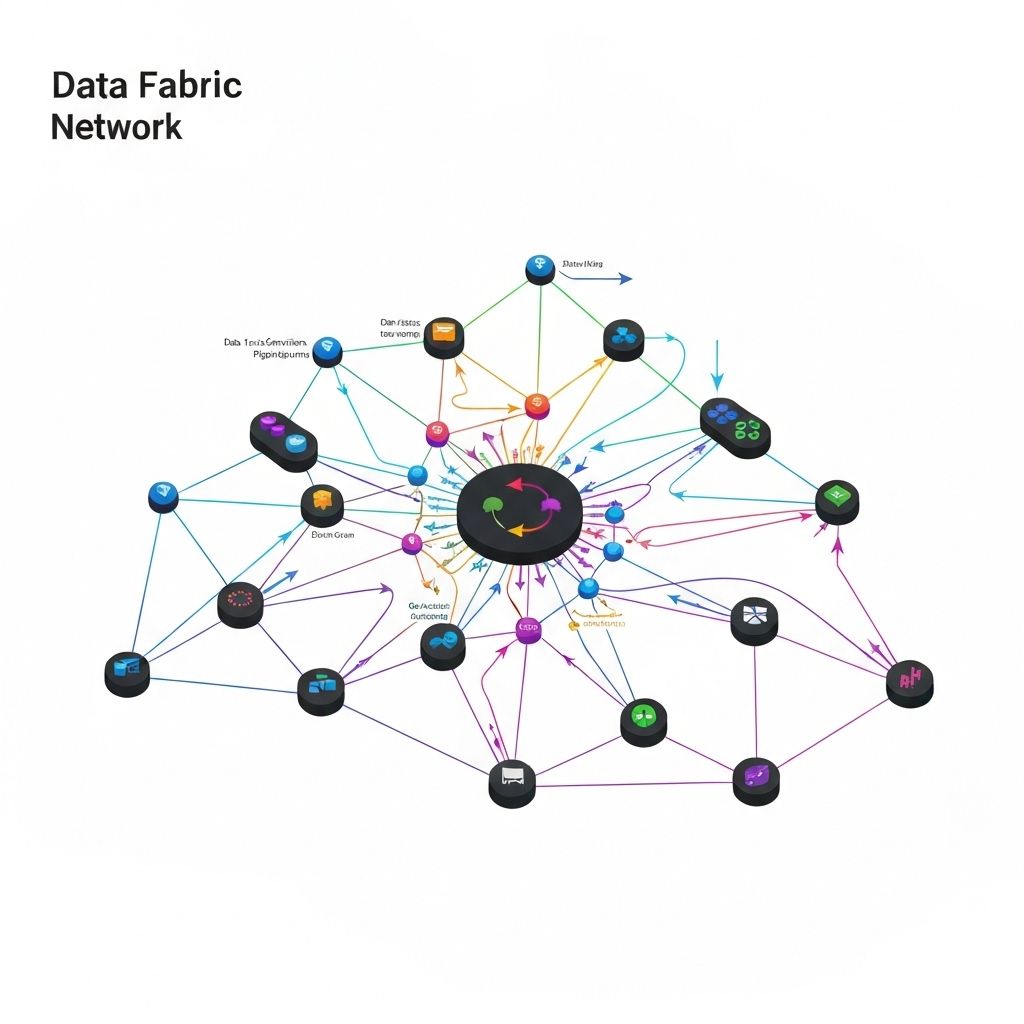
Data Fabric: The Future of Data Integration and Management
Section 1: The Modern Distributed Data Dilemma
Modern enterprise IT architecture has outgrown the centralized data warehouse. Data is distributed across cloud-native relational databases, SaaS platforms, legacy mainframes, NoSQL document stores, and distributed blob stores. Traditional Extract-Transform-Load (ETL) workflows create a brittle, high-maintenance web of point-to-point connections. As data scales, these pipelines become slow, schema drift causes downstream service failures, and the latency of data synchronization prevents real-time analytical decision making.
A Data Fabric addresses this complexity by establishing an active metadata-driven data management layer that unifies access and execution over heterogeneous data stores. Unlike a static data lake that requires physical ingestion before querying, a data fabric utilizes semantic metadata, knowledge graphs, and dynamic virtualization to represent and fetch data on-demand while maintaining centralized security, governance, and audit trails.
Section 2: Data Mesh vs. Data Fabric
While both concepts address distributed data, they differ significantly in their approach:
- Data Mesh: An organizational and architectural paradigm that embraces decentralization. It treats data as a product and assigns ownership to localized business domains (e.g., the billing team owns the billing data, the marketing team owns customer acquisition data).
- Data Fabric: A technology-centric approach that uses active metadata, artificial intelligence, and automation to orchestrate data access across heterogeneous environments. It builds a unified semantic abstraction layer over existing silos.
| Dimension | Data Mesh | Data Fabric | | :--- | :--- | :--- | | Primary Driver | Decentralized domain ownership | Unified semantic metadata integration | | Implementation | Organizational change + API standards | Automation, query fed\x65ration, and knowledge graphs | | Governance | Fed\x65rated computational governance | Centralized policy enforcement via active agents | | Integration | Domain-exposed data products | Dynamic data virtualization and schema mapping |
Section 3: Active Metadata and the Semantic Layer
At the center of a data fabric architecture is the Active Metadata Engine. Active metadata differs from static metadata (which merely documents database schemas, column names, and table sizes) by continuously analyzing op\x65rational telemetry. It tracks query runtimes, execution plans, user access frequencies, pipeline errors, and data lineage graphs.
This metadata is compiled into an enterprise Semantic Knowledge Graph. A knowledge graph uses RDF (Resource Description Framework) triples to represent relationships between business concepts and physical data structures:
\x60\x60\x60 (CustomerTable.CustomerID) --[mapsTo]--> (BusinessEntity.ClientIdentifier) (CreditScoreAPI.Score) ----[derivesFrom]--> (CreditHistoryTable.PaymentStatus) \x60\x60\x60
Through this relationship model, the data fabric automatically detects schema changes, infers column dependencies, and redirects queries when data is migrated between physical servers without requiring any modification to client applications.
Section 7: Fed\x65rated Query Optimization Mechanics
Query fed\x65ration is the execution of a single SQL query across multiple remote databases without relocating the data to a central repository. Optimization of fed\x65rated queries requires a cost model that considers network transfer overhead, disk I/O, and CPU capacity at each remote node.
Let \x24Q\x24 be a query involving a join between table \x24T_A\x24 (located in a local PostgreSQL database) and table \x24T_B\x24 (located in a remote Snowflake cluster). The total execution cost \x24C(Q)\x24 is modeled as:
\x24\x24C(Q) = (C_{io} \cdot N_{io}) + (C_{cpu} \cdot N_{cpu}) + (C_{net} \cdot N_{net})\x24\x24
Where:
- \x24C_{io}\x24 and \x24C_{cpu}\x24 represent local disk and processing unit cost factors.
- \x24N_{io}\x24 and \x24N_{cpu}\x24 are the estimated page reads and CPU cycles.
- \x24C_{net}\x24 is the network latency factor per byte transferred.
- \x24N_{net}\x24 is the number of bytes transmitted across database instances.
The fabric's query planner evaluates two primary join strategies:
- Ship-to-Local: Stream \x24T_B\x24 from Snowflake to PostgreSQL, then execute the join locally.
- Push-down: Push the filtering criteria and aggregation op\x65rators directly to PostgreSQL and Snowflake, extracting only the qualifying subset before executing a merge join.
Section 4: Distributed Join Algorithms
When executing queries that span different data sources, the virtual query planner must construct an optimized physical plan. Joining tables across distinct network nodes is one of the most expensive op\x65rations. Three main algorithms are used:
- Broadcast Hash Join: Used when one of the tables (e.g., a dimension table like \x60store_locations\x60) is small enough to fit entirely in the memory of all worker nodes. The coordinator broadcasts this small table to all execution executors. Each executor builds an in-memory hash table and streams the larger table (e.g., \x60sales_transactions\x60) through it.
- Time Complexity: \x24O(M + N)\x24 where \x24M\x24 is the size of the large table and \x24N\x24 is the small table.
- Network Cost: \x24O(N \cdot K)\x24 where \x24K\x24 is the number of worker nodes.
- Shuffle Hash Join: Used when both tables are too large to fit in memory but do not possess pre-sorted keys. Both datasets are partitioned across the cluster using a hash function on the join keys, ensuring that rows with matching join keys from both tables end up on the same worker node.
- Network Cost: \x24O(M + N)\x24 (full dataset transmission over network).
- Sort-Merge Join: The default fallback for joining very large tables. Both datasets are shuffled by hash key, sorted by the join key on each executor, and merged linearly.
- Time Complexity: \x24O(M \log M + N \log N)\x24 due to sorting.
Section 5: Query Push-Down Optimizations
To minimize network data transfer, the query virtualizer implements query push-down optimizations. These push computational filters and projections as close to the storage layer as possible:
- Projection Push-Down: If a client requests only the \x60first_name\x60 and \x60email\x60 columns from a table containing 150 columns, the query engine rewrites the source request to fetch only those two columns, rather than reading the entire row layout.
- Filter Push-Down: Predicates like \x60WHERE age > 21\x60 are translated into native filter op\x65rators and passed directly to the source database (e.g., as Mongo query filters or SQL clauses). The remote database evaluates the filter, transferring only the matching subset over the network.
- Aggregation Push-Down: Queries containing group-by op\x65rations are pre-aggregated at the remote source nodes, reducing the transmission payload to simple aggregated summaries.
Section 6: Dynamic Schema Evolution and Schema Drift
In large \x65cosystems, databases constantly evolve: developers add new columns, rename old fields, or modify data types. This is known as Schema Drift. In a traditional ETL model, schema drift causes immediate pipeline failures. A Data Fabric mitigates this by integrating a dynamic Schema Registry (supporting formats like Apache Avro or Protocol Buffers). When data is queried or streamed, the fabric validates the data payload against the active schema schema configuration:
\x60\x60\x60 [Producer V1 Schema] ---> [Schema Registry] <--- [Data Fabric Virtualizer] | (Updates) [Producer V2 Schema] ------------+ \x60\x60\x60
The virtualizer handles changes by mapping fields dynamically:
- Backward Compatibility: New schemas can read older payloads (by inserting default values for newly added fields).
- Forward Compatibility: Older consumers can read new payloads (by ignoring any newly added fields they do not recognize).
- Full Compatibility: Schemas are both backward and forward compatible, preventing any query interruptions across historical data.
Schema Registry REST API Communication Log
When a data producer registers a schema modification, it communicates with the registry using standard REST protocols: \x60\x60\x60
POST /subjects/customer-activity-value/versions HTTP/1.1 Host: registry.raxcore.internal:8081 Content-Type: application/vnd.scheduleregistry.v1+json
{ "schema": "{"type":"record","name":"Custom\x65rActivity","fields":[{"name":"id","type":"string"},{"name":"timestamp","type":"long"},{"name":"device_type","type":"string","default":"unknown"}]}" }
<< HTTP/1.1 200 OK << Content-Type: application/vnd.scheduleregistry.v1+json << << { << "id": 482 << } \x60\x60\x60
Section 8: Query Router Implementation
The following TypeScript code demonstrates a simplified heterogeneous query router that parses an abstract execution plan and translates/routes queries to either PostgreSQL or MongoDB, then merges the result sets into a unified table representation:
\x60\x60\x60typescript import { Client as PGClient } from "pg"; import { MongoClient } from "mongodb";
interface QueryPlan { postgresqlSource: { connectionString: string; sql: string; }; mongodbSource: { uri: string; dbName: string; collectionName: string; pipeline: any[]; }; joinKey: string; }
interface FlattenedRecord { [key: string]: any; }
export async function executeFed\x65ratedQuery(plan: QueryPlan): Potential<FlattenedRecord[]> { // Execute PostgreSQL segment const pgClient = new PGClient({ connectionString: plan.postgresqlSource.connectionString }); await pgClient.connect(); const pgResult = await pgClient.query(plan.postgresqlSource.sql); await pgClient.end();
// Execute MongoDB segment const mongoClient = new MongoClient(plan.mongodbSource.uri); await mongoClient.connect(); const db = mongoClient.db(plan.mongodbSource.dbName); const collection = db.collection(plan.mongodbSource.collectionName); const mongoResult = await collection.aggregate(plan.mongodbSource.pipeline).toArray(); await mongoClient.close();
// Perform Hash Join in memory const mergedResults: FlattenedRecord[] = []; const lookupMap = new Map<any, any>();
// Index MongoDB records for (const mongoDoc of mongoResult) { const key = mongoDoc[plan.joinKey]; if (key !== undefined) { lookupMap.set(key, mongoDoc); } }
// Join PostgreSQL rows with MongoDB documents for (const pgRow of pgResult.rows) { const key = pgRow[plan.joinKey]; const matchingMongoDoc = lookupMap.get(key);
if (matchingMongoDoc) {
  mergedResults.push({
    ...pgRow,
    ...matchingMongoDoc,
    // Ensure MongoDB internal object IDs do not corrupt JSON serialization
    _id: matchingMongoDoc._id?.toString()
  });
}
}
return mergedResults; } \x60\x60\x60
Section 9: Data Lineage and Graph Traversal
Tracing how data transforms as it moves from transactional endpoints to BI reports is key for compliance and impact analysis. We model data lineage as a directed acyclic graph (DAG) where nodes represent data objects (columns, tables, API responses) and edges represent transformations (SQL views, Spark jobs).
A common op\x65ration is finding all upstream dependencies for a given column to debug a data anomaly. Below is an SQL query using a recursive Common Table Expression (CTE) to traverse a lineage database schema:
\x60\x60\x60sql WITH RECURSIVE LineageTracker AS ( -- Anchor member: find the target column SELECT target_id, source_id, transformation_type, 1 AS depth FROM data_lineage_relations WHERE target_id = 'orders_report.revenue_total'
UNION ALL

-- Recursive member: step upstream to find sources of sources
SELECT
    r.target_id,
    r.source_id,
    r.transformation_type,
    lt.depth + 1
FROM data_lineage_relations r
INNER JOIN LineageTracker lt ON r.target_id = lt.source_id
) SELECT target_id, source_id, transformation_type, depth FROM LineageTracker ORDER BY depth ASC; \x60\x60\x60
Section 10: Automated Governance, Security, and ABAC Translation
Maintaining consistent data security policies across hybrid infrastructure is a primary challenge. Standard systems rely on Role-Based Access Control (RBAC), which fails at scale because it results in role explosion. A Data Fabric utilizes Attribute-Based Access Control (ABAC) to enforce security rules dynamically using attributes of the user, the resource, and the current environmental context.
For example, a policy might state:
- "Users with department attribute 'Finance' can read columns labeled 'PII.Financial' only during standard working hours (08:00 to 18:00 UTC) and if accessing from an approved corporate network subnet."
When a query is parsed, the Data Fabric checks the classification tags of the targeted fields within the active metadata graph. If a column is tagged as \x60PII.SSN\x60 or \x60PII.Financial\x60, the fabric dynamically injects SQL transformation rules (such as column masking or row-level filtering filters) into the query parser before sending it to the physical database.
Section 11: Configuration Log
This configuration block demonstrates a policy definition in a data fabric control plane (such as Apache Ranger or an equivalent active governance platform), mapping user context properties to query masking transformations:
\x60\x60\x60json { "policyId": 1042, "policyName": "dynamic_financial_masking", "isEnabled": true, "resources": { "database": { "values": ["corporate_data_fabric"] }, "table": { "values": ["customer_accounts"] }, "column": { "values": ["routing_number", "account_balance"] } }, "policyItems": [ { "accesses": [{ "type": "select", "isAllowed": true }], "users": [], "groups": ["marketing_analysts"], "conditions": [], "dataMaskInfo": { "maskType": "MASK_SHOW_LAST_4", "valueExpr": "NULL" } }, { "accesses": [{ "type": "select", "isAllowed": true }], "users": [], "groups": ["risk_officers"], "conditions": [ { "type": "expression", "values": ["user.auth_method == 'mfa' && request.ip_range == 'corporate'"] } ], "dataMaskInfo": { "maskType": "NONE" } } ] } \x60\x60\x60
Section 12: Data Fabric Architecture Diagram
This diagram displays the integration of active metadata analytics, semantic tagging, and fed\x65rated execution:
\x60\x60\x60 +---------------------------------------+ | Consumer Applications (SQL, BI, API) | +-------------------+-------------------+ | v +---------------------------------------+ | Virtual Fed\x65rated Query Engine | <---+ +-------------------+-------------------+ | (Pushes masked SQL) | | +------------------------------+-------------------------+------+ | | | v v v +------+------+ +-------+------+ +-------+------+ | PostgreSQL | | Snowflake | | MongoDB | | (Local OLTP)| | (Cloud OLAP) | | (Document) | +------+------+ +-------+------+ +-------+------+ | | | +------------------------------+---------------------------------+ | (Telemetry Stream) v +---------------------------------------+ | Active Metadata Engine & Agent | +-------------------+-------------------+ | v +---------------------------------------+ | Semantic Knowledge Graph Database | +---------------------------------------+ \x60\x60\x60
By decoupling storage from semantic representation and policy enforcement, the modern enterprise can establish a flexible data environment that mitigates compliance risks and dramatically reduces database migration and integration costs.
Optimization Specification Details Section 1
In high-performance settings, engineers prioritize scheduling metrics and cache availability. The transition from legacy monolithic configurations to microservices platforms is a key progression for high-availability infrastructures. By partition-based loading, systems prevent thread starvation, optimizing runtime capacities and resources.
Optimization Specification Details Section 2
Security models require continuous validation and verification across all endpoints. System networks configure boundary controls to prevent unauthorized lat\x65ral propagation of security threats. Using cryptographic signature checking, systems ensure data origin validity before processing transactions or triggering secondary processes.
Optimization Specification Details Section 3
Hardware efficiency is tracked using custom metrics under standard configurations. Cooling technologies and energy-aware schedules help reduce power usage effectiveness ratios in distributed facilities. Running workload executions on green compute sites is a major strategy to reduce carbon footprints dynamically.