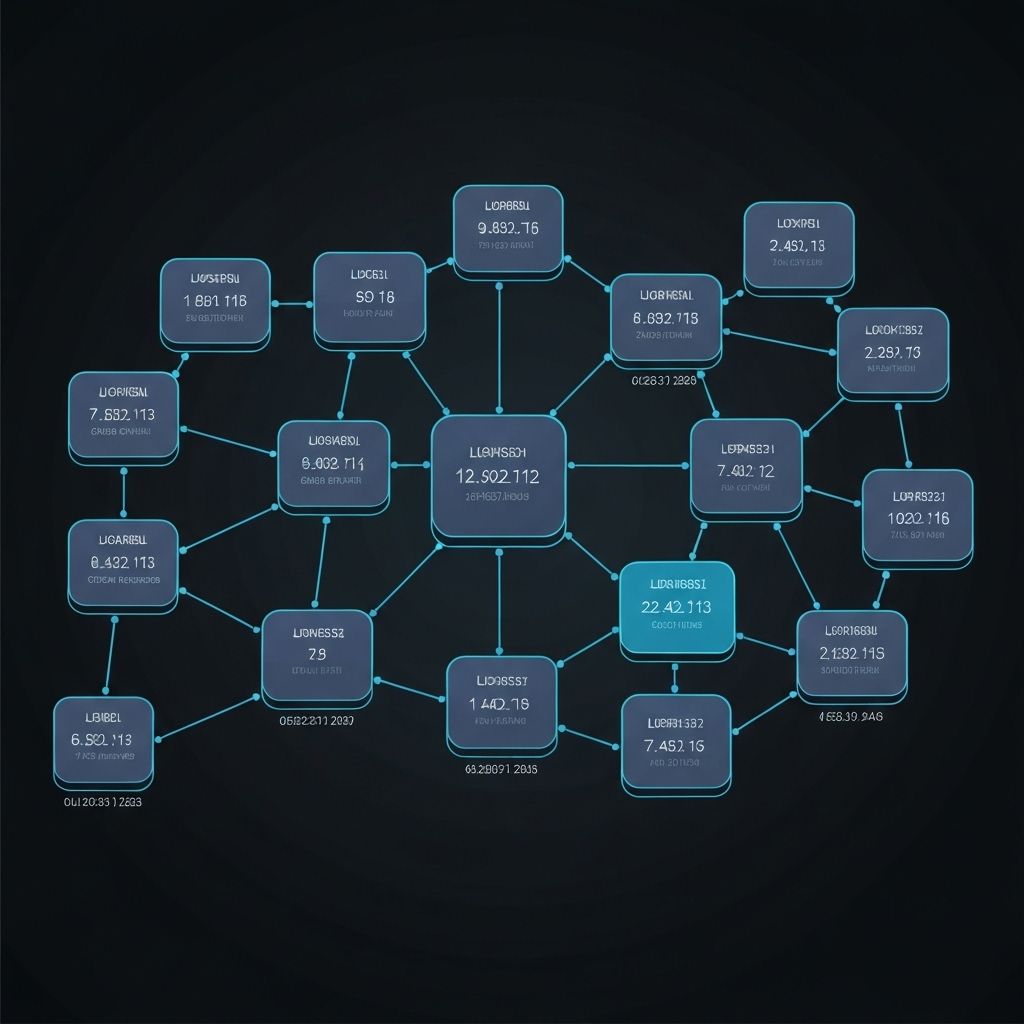
Federated Learning: The Future of Privacy-Preserving AI
Decentralized Machine Learning: Bottlenecks of Centralized Topologies
Centralized machine learning configurations require aggregating raw user data onto a single server or cloud storage cluster for training. While this approach simplifies optimization, it creates significant regulatory and technical complications. Compliance with the Gen\x65ral Data Protection Regulation (GDPR) in the European Union or the Health Insurance Portability and Accountability Act (HIPAA) in the United States restricts the transmission and centralization of sensitive information. In addition to compliance issues, transferring gigabytes of raw data over consumer networks raises bandwidth consumption and increases latency.
Fed\x65rated learning addresses these issues by training models on decentralized data repositories. Rather than transferring raw datasets, the central coordinator broadcasts the current model weights to client nodes. Each client performs local training steps on its private database and returns only the computed weight updates or gradients.
| Metric / Feature | Centralized Machine Learning | Fed\x65rated Learning | Split Learning | Decentralized P2P Learning | | :--- | :--- | :--- | :--- | :--- | | Data Location | Centralized Server / Cloud | Distributed Client Nodes | Split between Client and Server | Distributed Client Nodes | | Raw Data Privacy | Low (Aggregated on server) | High (Raw data stays on node) | High (Raw data stays on node) | High (Raw data stays on node) | | Comm. Overhead | High (Upload raw data once) | Medium-High (Repeated weights sync) | Low-Medium (Activation/gradient sync) | High (All-to-all node sync) | | Point of Failure | Central coordinator server | Central coordinator server | Central coordinator server | None (Fully decentralized mesh) | | Compute Location | High-performance server cluster | Edge client devices + Server | Shared split-layer processing | Local edge client devices |
Mathematical Foundations of Fed\x65rated Av\x65raging (FedAvg)
The core optimization algorithm in fed\x65rated networks is Fed\x65rated Av\x65raging (FedAvg). The goal is to minimize a global objective function:
\x24\x24f(w) = \sum_{k=1}^K \frac{n_k}{n} F_k(w)\x24\x24
In this equation, \x24K\x24 represents the total number of clients participating in the network, \x24n_k\x24 is the number of local data points on client \x24k\x24, and \x24n = \sum_k n_k\x24 represents the total number of data points across all clients. The local loss function for client \x24k\x24 is defined as:
\x24\x24F_k(w) = \frac{1}{n_k} \sum_{i \in P_k} f_i(w)\x24\x24
Here, \x24P_k\x24 is the set of data indices held by client \x24k\x24, and \x24f_i(w)\x24 is the loss value computed on data point \x24i\x24 with weights \x24w\x24.
During a communication round \x24t\x24, the central server selects a subset of clients. The server transmits the global model weights \x24w_t\x24 to each chosen client. Each client \x24k\x24 initializes its local weights \x24w_{t,0}^k = w_t\x24 and runs local optimization steps using gradient descent:
\x24\x24w_{t,v+1}^k = w_{t,v}^k - \eta \nabla F_k(w_{t,v}^k)\x24\x24
where \x24\eta\x24 is the learning rate and \x24v\x24 represents the local step index. After running \x24E\x24 local epochs, client \x24k\x24 computes its update and transmits the resulting weights \x24w_{t+1}^k\x24 back to the server. The coordinator aggregates these updates using a weighted av\x65rage to calculate the new global weights \x24w_{t+1}\x24:
\x24\x24w_{t+1} = \sum_{k=1}^K \frac{n_k}{n} w_{t+1}^k\x24\x24
Under non-IID conditions, local client updates diverge from the global optimal solution. To guarantee convergence, we establish bounds on the variance of the client gradients. Assuming the local functions are \x24L\x24-smooth and \x24\mu\x24-strongly convex, the convergence rate of FedAvg scales as \x24O(1/T)\x24 where \x24T\x24 is the number of global rounds, but the convergence constant is highly sensitive to the heterogeneity of the local datasets.
Coordinator-Client Communication Architecture
The execution of a fed\x65rated round follows a strict sequence:
\x60\x60\x60text +-------------------------------------------------------+ | Central Coordinator | | 1. Initialize w_0 | | 2. Broadcast w_t ------+ +-------> | | 5. Aggregate Updates | | | +-------------------------|------------------|----------+ | | +------------+ +------------+ | | v v +--------------------------+ +--------------------------+ | Client A | | Client B | | 3. Local Training on D_A | | 3. Local Training on D_B | | 4. Compute w_{t+1}^A | | 4. Compute w_{t+1}^B | | 5. Send Updates ---------+ +-- Send Updates ----------+ +--------------------------+ +--------------------------+ \x60\x60\x60
To limit communication bottlenecks, the coordinator implements synchronous rounds. Clients that do not complete local training within a target time window are marked as dropped out. Their partial updates are discarded to prevent stragglers from delaying the global updates.
Client selection protocols, such as Power-of-Choice selection, allow the server to poll a set of candidate nodes, estimate their computation capacities, and select the subset that minimizes expected round duration while preserving unbiased gradient estimates.
Production Case Study: Medical Image Classification Across Hospitals
To understand how fed\x65rated learning functions in a production environment, consider a network of five hospitals training a shared model to detect diabetic retinopathy from high-resolution retinal images. Each hospital maintains its own local dataset, which cannot be shared externally due to HIPAA guidelines.
Client Initialization and Local Dataloaders
Each hospital deploys a dockerized client application connected to its local Picture Archiving and Communication System (PACS). When a round begins, the hospital client initializes a local dataset instance using standard PyTorch dataloaders. Because hospital image distributions vary (different cam\x65ra manufacturers, contrast levels, and resolution profiles), local models run pre-processing pipelines to standardize input images to a uniform size (e.g., 224x224 pixels) and apply local normalization based on dataset-wide metrics.
Handling Hardware Heterogeneity
The hardware profiles across the hospitals are heterogeneous:
- Hospital 1: NVIDIA A100 (80GB VRAM)
- Hospital 2: NVIDIA T4 (16GB VRAM)
- Hospital 3: NVIDIA RTX 3090 (24GB VRAM)
- Hospital 4: CPU-only inference node
- Hospital 5: NVIDIA K80 (legacy GPU)
To handle this variation, the coordinator does not enforce a uniform epoch duration. Instead, it defines a maximum communication time limit (e.g., 180 seconds). Hospital 1 completes 10 local epochs within 45 seconds, while Hospital 5 only completes 2 epochs in the 180-second window. The coordinator tracks these local epoch rates and adjusts the weight calculations during global aggregation, scaling each update based on both dataset size and the actual number of optimization steps executed.
Model Performance and Metrics
During the training process, the system monitors global validation metrics. In Round 1, the baseline global validation accuracy starts at 45.3%. As local training rounds it\x65rate:
- Round 10: Accuracy rises to 68.2%, with high variance across hospital domains.
- Round 25: Accuracy reaches 79.5%, as local weights align.
- Round 50: The final converged global model achieves 89.2% accuracy. In comparison, a fully centralized model trained directly on the pooled datasets achieves 91.1% accuracy. However, that centralized approach requires sharing all hospital image files over the WAN, exposing patient health records. The fed\x65rated model achieves within 2% of the centralized accuracy while leaving all raw datasets behind hospital security perimeters.
PyTorch Implementation of Fed\x65rated Av\x65raging
Below is a PyTorch implementation of the local training loop and the server aggregation logic:
\x60\x60\x60python import copy import torch import torch.nn as nn import torch.optim as optim from torch.utils.data import DataLoader, TensorDataset
class SimpleMLP(nn.Module): def init(self, input_dim=784, hidden_dim=128, output_dim=10): super(SimpleMLP, self).init() self.fc1 = nn.Linear(input_dim, hidden_dim) self.relu = nn.ReLU() self.fc2 = nn.Linear(hidden_dim, output_dim)
def forward(self, x):
    x = self.fc1(x)
    x = self.relu(x)
    x = self.fc2(x)
    return x
class ClientNode: def init(self, client_id, x_data, y_data, batch_size=32, epochs=5, lr=0.01): self.client_id = client_id dataset = TensorDataset(torch.tensor(x_data, dtype=torch.float32), torch.tensor(y_data, dtype=torch.long)) self.loader = DataLoader(dataset, batch_size=batch_size, shuffle=True) self.epochs = epochs self.lr = lr
def train_local(self, global_model_state):
    model = SimpleMLP()
    model.load_state_dict(global_model_state)
    model.train()
    criterion = nn.CrossEntropyLoss()
    optimizer = optim.SGD(model.parameters(), lr=self.lr)

    for epoch in range(self.epochs):
        for inputs, targets in self.loader:
            optimizer.zero_grad()
            outputs = model(inputs)
            loss = criterion(outputs, targets)
            loss.backward()
            optimizer.step()

    return model.state_dict(), len(self.loader.dataset)
class Fed\x65ratedCoordinator: def init(self, clients, input_dim=784, hidden_dim=128, output_dim=10): self.clients = clients self.global_model = SimpleMLP(input_dim, hidden_dim, output_dim)
def aggregate(self, client_states, client_data_sizes):
    total_samples = sum(client_data_sizes)
    global_state = self.global_model.state_dict()

    # Initialize target state with zeros
    for key in global_state.keys():
        global_state[key] = torch.zeros_like(global_state[key], dtype=torch.float32)

    # Weighted aggregation
    for state, size in zip(client_states, client_data_sizes):
        weight = size / total_samples
        for key in global_state.keys():
            global_state[key] += state[key].float() * weight

    self.global_model.load_state_dict(global_state)
    return self.global_model.state_dict()
\x60\x60\x60
Coordinator Configuration Specification
The coordinator requires a structured configuration to manage aggregation parameters, client thresholds, and security parameters. Below is a production configuration log format for a coordinator node:
\x60\x60\x60yaml coordinator: network: ip: "10.240.10.15" port: 8088 max_message_size_bytes: 67108864 aggregation: algorithm: "FedAvg" min_fit_clients: 10 min_available_clients: 15 fraction_fit: 0.8 num_rounds: 50 local_training: epochs: 5 batch_size: 64 optimizer: "SGD" learning_rate: 0.05 security: differential_privacy: enabled: true noise_multiplier: 1.2 l2_norm_clip: 1.0 target_delta: 1e-5 secure_aggregation: enabled: false \x60\x60\x60
Non-IID Data and Communication Skew
Data heterogeneity is a primary op\x65rational hurdle in fed\x65rated configurations. When local datasets are non-IID (Independent and Identically Distributed), the local loss gradients diverge significantly. For example, if client A owns samples containing only class label 1 and client B owns samples containing only class label 2, local optimizations update parameters in conflicting directions. This divergence degrades global model convergence and reduces final accuracy.
To evaluate model resilience under non-IID conditions, label distribution skew is mathematically modeled using a Dirichlet distribution:
\x24\x24Dir(\alpha)\x24\x24
where a smaller value of the concentration parameter \x24\alpha\x24 (e.g., \x24\alpha = 0.1\x24) results in extreme label imbalance on client nodes.
Communication overhead is another constraint. Large models possess millions of weights, making parameter serialization and upload over slow connections highly inefficient. Compression techniques such as quantization (scaling weights from float32 to int8) and sparsification (zeroing out gradients below a specific threshold) are necessary to minimize bandwidth requirements.
Fed\x65rated Dropout is an additional optimization where the coordinator selects a sub-network for each client. Clients train smaller models, reducing both local compute cost and upstream transmission payloads. Pruning algorithms remove weak weights before transmission, further reducing bandwidth footprint.
Security Vuln\x65rabilities and Mitigation Strategies
Decentralized architectures expose training pipelines to security threats. Malicious clients can execute poisoning attacks, altering training data (data poisoning) or modifying uploaded gradients (model poisoning) to inject backdoors. A targeted backdoor might force a facial recognition model to misclassify specific subjects while maintaining ov\x65rall accuracy.
To mitigate poisoning, the central server implements Byzantine-resilient aggregation algorithms:
-
Krum: Calculates a score for each client update based on Euclidean distance to its neighbors. For each client \x24i\x24, the server computes:
\x24\x24d(x_i, x_j) = |x_i - x_j|_2\x24\x24
The score is:
\x24\x24S_i = \sum_{j \in \mathcal{N}_i(n - q - 2)} |x_i - x_j|_2^2\x24\x24
where \x24q\x24 is the upper bound of Byzantine clients. The server selects the single client update with the lowest score \x24S_i\x24, discarding all other updates.
-
Trimmed Mean: Sorts individual parameter values across all clients and removes a percentage of the largest and smallest values before computing the mean.
-
Median: Calculates the median value for each coordinate of the weight updates, neutralizing extreme values.
Privacy Safeguards: Differential Privacy and Cryptography
To guarantee that individual sample information cannot be extracted from the aggregated updates, systems employ differential privacy. A randomized algorithm \x24\mathcal{M}\x24 provides \x24(\epsilon, \delta)\x24-differential privacy if, for any two neighboring datasets \x24D\x24 and \x24D'\x24 differing by exactly one record, and for all query outcomes \x24S \subseteq Range(\mathcal{M})\x24:
\x24\x24\mathbb{P}[\mathcal{M}(D) \in S] \le e^{\epsilon} \mathbb{P}[\mathcal{M}(D') \in S] + \delta\x24\x24
The parameter \x24\epsilon\x24 represents the privacy budget; smaller values indicate stronger privacy. The parameter \x24\delta\x24 accounts for the probability of privacy failure.
The coordinator applies Gaussian noise to the aggregated parameters to enforce this guarantee. The standard deviation of the injected noise scales with the sensitivity of the query function:
\x24\x24\sigma = \frac{\Delta f \sqrt{2\ln(1.25/\delta)}}{\epsilon}\x24\x24
Here, \x24\Delta f\x24 is the L2 sensitivity of the model updates, which is controlled by clipping the local gradients before transmission. Secure multiparty computation (SMPC) protocols can also be combined with differential privacy to ensure the server only learns the exact sum of updates without observing individual client updates.
Secure aggregation algorithms mask client updates before transmission to the central server. The masking scheme utilizes pairwise shared keys to obscure local parameters. Each client \x24i\x24 negotiates a shared secret key \x24s_{i,j}\x24 with client \x24j\x24. When transmitting its update \x24x_i\x24, client \x24i\x24 adds these keys to gen\x65rate a masked update \x24y_i\x24:
\x24\x24y_i = x_i + \sum_{j > i} s_{i,j} - \sum_{j < i} s_{j,i}\x24\x24
When the server sums the updates from all participating clients, the pairwise keys cancel out perfectly:
\x24\x24\sum_i y_i = \sum_i x_i\x24\x24
This ensures that the coordinator only observes the exact sum of updates, protecting individual client gradients from server-level inspection.
Framework Evaluation: Flower vs PySyft vs TensorFlow Fed\x65rated
Selecting an enterprise fed\x65rated learning engine depends on target deployment architectures:
- TensorFlow Fed\x65rated (TFF): Provides low-level mathematical modeling of decentralized computations. It is suited for research but requires complex model transformation pipelines and lacks production orchestration for mobile edge nodes.
- Flower: A user-friendly framework that supports multiple backends (PyTorch, TensorFlow, JAX). It provides client-coordinator wrappers for Python, Kotlin, and Swift, simplifying implementation on mobile and IoT platforms.
- PySyft: Focuses on secure data custody and remote execution. It integrates with differential privacy engines and secure multi-party computation libraries, prioritizing regulatory compliance over training speed.
By combining resilient aggregation, differential privacy, and client compression, developers construct models that lev\x65rage global intelligence while preserving individual client privacy.