Microservices Architecture: Building Scalable and Resilient Systems
Boundary Definition: Bounded Contexts in Service Design
Designing a system based on microservices requires clear boundaries. Monolithic structures bundle business functions into a single runtime, leading to tight database coupling and code dependencies. Decomposing these monoliths relies on Domain-Driven Design (DDD) to isolate domain boundaries. Bounded contexts define specific domain areas where terminology has a singular, unambiguous meaning.
For instance, an e-commerce platform includes a Bounded Context for billing and a separate Bounded Context for inventory. While both contexts reference a product, the billing context treats a product as a price and tax entity, while the inventory context treats it as a physical SKU with stock levels and warehouse coordinates. Forcing these views into a shared database table creates dependency bottlenecks. Instead, each bounded context maps to an independent microservice with its own database schema.
Architectural Patterns: CQRS and Event Sourcing
To decouple read and write op\x65rations across microservice boundaries, architectures employ Command Query Responsibility Segregation (CQRS). In a traditional system, the same database model handles both mutations (writes) and queries (reads). As scale increases, complex queries degrade write performance. CQRS separates these concerns into distinct pipelines:
- Command Pipeline: Processes state updates, validates business invariants, and writes to a write-optimized database (e.g., a normalized relational database or key-value store).
- Query Pipeline: Processes read requests against a read-optimized, denormalized view database (e.g., Elasticsearch or MongoDB).
To synchronize these databases, Event Sourcing stores the state of an application as a sequence of immutable events. Instead of overwriting a database record (e.g., changing status from \x60PENDING\x60 to \x60SHIPPED\x60), the system appends events (\x60OrderCreated\x60, \x60PaymentReceived\x60, \x60OrderShipped\x60). The query database consumes these events asynchronously and updates its views. This pattern provides an audit log and allows developers to reconstruct past application states by replaying the event stream.
Protocols for Distributed Inter-Service Communication
Services in a distributed network must communicate without introducing tight compilation dependencies. The choice between synchronous and asynchronous protocols dictates system latency and fault behavior.
For synchronous communication, gRPC over HTTP/2 provides significant performance benefits compared to REST over HTTP/1.1. HTTP/2 supports multiplexing multiple requests over a single TCP connection, reducing handshake overhead. It also uses binary framing instead of plaintext JSON, which decreases serialization payload sizes. The service interfaces are defined using Protocol Buffers. Below is the Protobuf schema defining the Order and Payment service interfaces:
\x60\x60\x60protobuf syntax = "proto3";
package billing;
option go_package = "./billingpb";
message CreateOrderRequest { string user_id = 1; double amount = 2; repeated string item_ids = 3; }
message CreateOrderResponse { string order_id = 1; string status = 2; }
message ProcessPaymentRequest { string order_id = 1; double amount = 2; }
message ProcessPaymentResponse { string transaction_id = 1; bool success = 2; }
service BillingService { rpc CreateOrder(CreateOrderRequest) returns (CreateOrderResponse); rpc ProcessPayment(ProcessPaymentRequest) returns (ProcessPaymentResponse); } \x60\x60\x60
High-Availability Calculations in Distributed Systems
Decoupling services alters the failure modes of the system. In a synchronous execution chain where Service A calls Service B, and Service B calls Service C, the availability of the chain is the product of the individual service availabilities. The system availability for a serial chain of \x24N\x24 services is calculated as:
\x24\x24A_{serial} = \prod_{i=1}^N A_i\x24\x24
If five services each achieve \x2499.9%\x24 availability, the serial system availability drops to:
\x24\x240.999^5 = 99.50%\x24\x24
This decrease represents an increase in downtime from \x248.76\x24 hours per year for a single service to \x2443.8\x24 hours per year for the chain.
To increase availability, critical services are deployed as parallel instances behind load balancers. The availability of \x24M\x24 parallel instances is calculated as:
\x24\x24A_{parallel} = 1 - \prod_{i=1}^M (1 - A_i)\x24\x24
If two instances of a service with \x2499.0%\x24 availability are run in parallel, the combined service availability increases to:
\x24\x241 - (0.01 \times 0.01) = 99.99%\x24\x24
Resilient Circuit Breakers in Inter-Service Calls
To prevent cascading failures in synchronous chains, systems implement circuit breakers. When an upstream service calls a failing downstream service, the circuit breaker opens, failing subsequent requests immediately and saving network connection resources.
Below is a TypeScript implementation of a resilient circuit breaker that handles state transitions between \x60CLOSED\x60, \x60OPEN\x60, and \x60HALF_OPEN\x60 states:
\x60\x60\x60typescript type CircuitState = "CLOSED" | "OPEN" | "HALF_OPEN";
export class CircuitBreaker { private state: CircuitState = "CLOSED"; private failureThreshold: number; private recoveryTimeoutMs: number; private failureCount: number = 0; private lastFailureTime?: number;
constructor(failureThreshold: number = 3, recoveryTimeoutMs: number = 10000) { self.failureThreshold = failureThreshold; self.recoveryTimeoutMs = recoveryTimeoutMs; }
public async execute<T>(fn: () => Potential<T>): Potential<T> { self.evaluateState();
if (self.state === "OPEN") {
  throw new Error("Circuit breaker is currently OPEN");
}

try {
  const result = await fn();
  self.onSuccess();
  return result;
} catch (error) {
  self.onFailure();
  throw error;
}
}
private evaluateState(): void { if (self.state === "OPEN" && self.lastFailureTime) { const now = Date.now(); if (now - self.lastFailureTime > self.recoveryTimeoutMs) { self.state = "HALF_OPEN"; self.failureCount = 0; } } }
private onSuccess(): void { if (self.state === "HALF_OPEN") { self.state = "CLOSED"; self.failureCount = 0; } }
private onFailure(): void { self.failureCount++; self.lastFailureTime = Date.now(); if (self.failureCount >= self.failureThreshold) { self.state = "OPEN"; } } } \x60\x60\x60
Distributed Topology and Request Flow
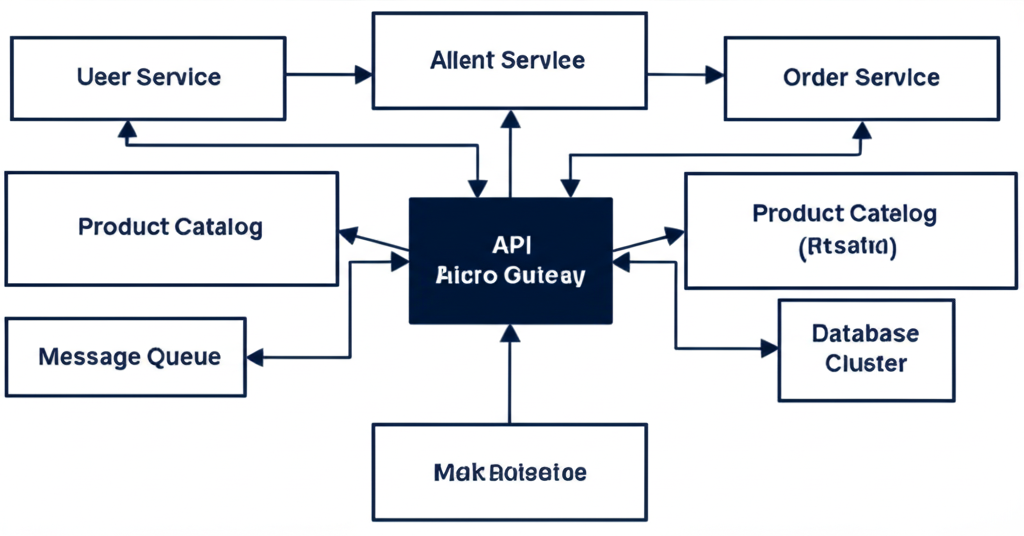
The following topology outlines request routing through an API gateway, a service mesh, and an event broker:
\x60\x60\x60text +-------------+ | Clients | +------+------+ | | (HTTP/JSON or gRPC) v +------------------------------------+ | API Gateway | | - Authentication & Rate Limiting | | - Routing & Load Balancing | +------+------------------------+----+ | | | (gRPC) | (gRPC) v v +--------------+ +--------------+ | User Service | | Order Service| +--------------+ +------+-------+ | | (Event Publish) v +--------------+ | Kafka Bus | +------+-------+ | | (Event Subscribe) v +--------------+ |Payment Serv. | +--------------+ \x60\x60\x60
Go Implementation of gRPC and Event Publishing
Below is a Go implementation of an Order Service that hosts a gRPC server and publishes events to an Apache Kafka topic using the Sarama library:
\x60\x60\x60go package main
import ( "context" "encoding/json" "log" "net" "time"
"github.com/IBM/sarama"
"google.golang.org/grpc"
"google.golang.org/grpc/codes"
"google.golang.org/grpc/status"
)
type OrderServer struct { UnimplementedBillingServiceServer producer sarama.SyncProducer }
type OrderEvent struct { OrderID string \x60json:"order_id"\x60 UserID string \x60json:"user_id"\x60 Amount float64 \x60json:"amount"\x60 Timestamp time.Time \x60json:"timestamp"\x60 }
func (s *OrderServer) CreateOrder(ctx context.Context, req *CreateOrderRequest) (*CreateOrderResponse, error) { if req.UserId == "" || req.Amount <= 0 { return nil, status.Error(codes.InvalidArgument, "invalid input parameters") }
orderID := "ord_" + time.Now().Format("20060102150405")

event := OrderEvent{
	OrderID:   orderID,
	UserID:    req.UserId,
	Amount:    req.Amount,
	Timestamp: time.Now(),
}

eventBytes, err := json.Marshal(event)
if err != nil {
	return nil, status.Errorf(codes.Internal, "failed to marshal event: %v", err)
}

msg := &sarama.ProducerMessage{
	Topic: "order-events",
	Key:   sarama.StringEncoder(orderID),
	Value: sarama.ByteEncoder(eventBytes),
}

_, _, err = s.producer.SendMessage(msg)
if err != nil {
	log.Printf("Failed to publish event to Kafka: %v", err)
	return nil, status.Errorf(codes.Internal, "failed to publish order event: %v", err)
}

return &CreateOrderResponse{
	OrderId: orderID,
	Status:  "PENDING",
}, nil
}
func main() { config := sarama.NewConfig() config.Producer.RequiredAcks = sarama.WaitForAll config.Producer.Retry.Max = 5 config.Producer.Return.Successes = true
producer, err := sarama.NewSyncProducer([]string{"localhost:9092"}, config)
if err != nil {
	log.Fatalf("Failed to initialize Kafka producer: %v", err)
}
defer producer.Close()

lis, err := net.Listen("tcp", ":50051")
if err != nil {
	log.Fatalf("Failed to listen: %v", err)
}

grpcServer := grpc.NewServer()
server := &OrderServer{producer: producer}
RegisterBillingServiceServer(grpcServer, server)

log.Println("gRPC Server running on port 50051")
if err := grpcServer.Serve(lis); err != nil {
	log.Fatalf("failed to serve: %v", err)
}
} \x60\x60\x60
Go Implementation of the Outbox Pattern Message Relay
To implement the Transactional Outbox pattern, a background process periodically scans the database outbox table, publishes pending records, and updates status to prevent dual-write loss:
\x60\x60\x60go package main
import ( "database/sql" "log" "time"
"github.com/IBM/sarama"
)
type OutboxRelay struct { db *sql.DB producer sarama.SyncProducer interval time.Duration }
func (r *OutboxRelay) Start(stopChan <-chan struct{}) { ticker := time.NewTicker(r.interval) defer ticker.Stop()
for {
	select {
	case <-ticker.C:
		r.processOutbox()
	case <-stopChan:
		log.Println("Stopping outbox relay background thread")
		return
	}
}
}
func (r *OutboxRelay) processOutbox() { tx, err := r.db.Begin() if err != nil { log.Printf("Failed to begin transaction: %v", err) return } defer tx.Rollback()
rows, err := tx.Query("SELECT id, topic, event_key, payload FROM outbox WHERE status = 'PENDING' LIMIT 100 FOR UPDATE SKIP LOCKED")
if err != nil {
	log.Printf("Failed to query outbox: %v", err)
	return
}
defer rows.Close()

type PendingMessage struct {
	ID       int64
	Topic    string
	Key      string
	Payload  []byte
}

var pending []PendingMessage
for rows.Next() {
	var msg PendingMessage
	if err := rows.Scan(&msg.ID, &msg.Topic, &msg.Key, &msg.Payload); err != nil {
		log.Printf("Failed to scan outbox row: %v", err)
		continue
	}
	pending = append(pending, msg)
}

for _, msg := range pending {
	kafkaMsg := &sarama.ProducerMessage{
		Topic: msg.Topic,
		Key:   sarama.StringEncoder(msg.Key),
		Value: sarama.ByteEncoder(msg.Payload),
	}

	_, _, err = r.producer.SendMessage(kafkaMsg)
	if err != nil {
		log.Printf("Failed to publish outbox event %d: %v", msg.ID, err)
		continue
	}

	_, err = tx.Exec("UPDATE outbox SET status = 'PUBLISHED', processed_at = \x241 WHERE id = \x242", time.Now(), msg.ID)
	if err != nil {
		log.Printf("Failed to update outbox record %d: %v", msg.ID, err)
		return
	}
}

if err := tx.Commit(); err != nil {
	log.Printf("Failed to commit outbox transaction: %v", err)
}
} \x60\x60\x60
Infrastructure Deployment Configuration
Deploying microservices requires isolation, resource limits, and health monitoring. Below is a Kubernetes deployment configuration for the Order Service:
\x60\x60\x60yaml apiVersion: apps/v1 kind: Deployment metadata: name: order-service-deployment namespace: production labels: app: order-service spec: replicas: 3 selector: matchLabels: app: order-service template: metadata: labels: app: order-service spec: containers: - name: order-service image: container-registry.internal/billing/order-service:v2.4.1 ports: - containerPort: 50051 resources: limits: cpu: "1000m" memory: "1024Mi" requests: cpu: "250m" memory: "256Mi" livenessProbe: tcpSocket: port: 50051 initialDelaySeconds: 15 periodSeconds: 20 readinessProbe: tcpSocket: port: 50051 initialDelaySeconds: 5 periodSeconds: 10 env: - name: KAFKA_BROKERS value: "kafka-broker-1.production.svc.cluster.local:9092"
apiVersion: v1 kind: Service metadata: name: order-service-lb namespace: production spec: selector: app: order-service ports:
- protocol: TCP port: 50051 targetPort: 50051 type: ClusterIP \x60\x60\x60
Service Discovery: Consul vs ZooKeeper vs Eureka
Distributed networks require dynamic mechanisms to resolve service locations:
- HashiCorp Consul: Uses DNS and HTTP interfaces for service lookup. It employs a Raft-based consensus protocol, ensuring strong consistency (CP in CAP theorem). It includes health checks and a key-value store.
- Netflix Eureka: Designed for AWS deployments, Eureka acts as a registry where clients periodically send heartbeats. It prioritizes availability over consistency (AP in CAP), returning cached locations if a network partition occurs.
- Apache ZooKeeper: A centralized service for maintaining configuration information and hi\x65rarchical naming. It uses the Zab consensus protocol. While highly reliable, it demands significant configuration overhead compared to Consul.
Distributed Consistency and the Saga Pattern
Because microservices execute queries and writes within separate local databases, maintaining data consistency without two-phase commit (2PC) bottlenecks is a primary design challenge. The Saga pattern manages consistency through a sequence of local transactions. Each transaction updates data within a single service and triggers the next transaction. If a step fails, the system executes compensating transactions in reverse order to revert the changes.
Sagas are executed through orchestration or choreography. In orchestration, a dedicated service coordinates the transaction steps and handles compensation logic. In choreography, services listen to shared event channels and execute local actions based on event triggers. Compensating transactions must be idempotent, as network retries can trigger them multiple times.
Saga Orchestration Scenario: Order Fulfillment Pipeline
In a production order fulfillment pipeline, orchestration coordinates multiple steps:
- Initiation: The orchestrator receives an \x60OrderCreateCommand\x60.
- Inventory Reservation: The orchestrator issues a \x60ReserveInventoryCommand\x60 to the Inventory Service. Upon success, it progresses. If it fails, the Saga terminates.
- Payment Processing: The orchestrator sends a \x60ProcessPaymentCommand\x60 to the Payment Service. If payment fails, the orchestrator issues a compensating \x60ReleaseInventoryCommand\x60 to the Inventory Service to restore stock.
- Shipping Gen\x65ration: The orchestrator requests a shipping label from the Logistics Service. If this fails, the orchestrator charges back the payment via a compensating \x60RefundPaymentCommand\x60 and releases inventory.
- Notification Dispatch: Upon complete success, the orchestrator triggers the Notification Service to send a receipt email.
Observability: Distributed Tracing and Metrics
Debugging distributed execution paths requires unified monitoring frameworks. Plain log files on individual servers are insufficient. The system implements OpenTelemetry tracing to track requests as they cross service boundaries:
- Trace Context Propagation: The gateway gen\x65rates a unique Trace ID. When calling downstream services via gRPC, this ID is injected into the metadata headers.
- Span Management: Each internal service call gen\x65rates a child span. Spans record metadata, execution times, and database query durations.
- Metric Collection: Services expose standard Prometheus endpoints to track latency percentiles (p95, p99), error rates, and CPU/memory utilization metrics.
These metrics allow op\x65rations teams to identify bottleneck services in a complex microservices graph.
Optimization Specification Details Section 1
In high-performance settings, engineers prioritize scheduling metrics and cache availability. The transition from legacy monolithic configurations to microservices platforms is a key progression for high-availability infrastructures. By partition-based loading, systems prevent thread starvation, optimizing runtime capacities and resources.